English content for this article is being prepared. Please switch to Chinese to read the full article.
What Is "Situational Awareness"?
"Situational Awareness: The Decade Ahead" is a landmark 165-page essay published in June 2024 by Leopold Aschenbrenner, a former member of OpenAI's Superalignment team and founder of the AI-focused hedge fund Situational Awareness LP. It argues that AGI (Artificial General Intelligence) could arrive by 2027 and lays out the massive industrial, geopolitical, and existential implications.
This article provides comprehensive reading notes and key conclusions from all seven chapters, designed for investors who need to understand the most consequential technology thesis of the decade.
"We are sitting on a high-speed train whose velocity doubles every year. Most passengers are still debating why the scenery outside looks increasingly blurry, without realizing that we are about to break the sound barrier."
Chapter 1: Introduction — The Intelligence Explosion Is Near
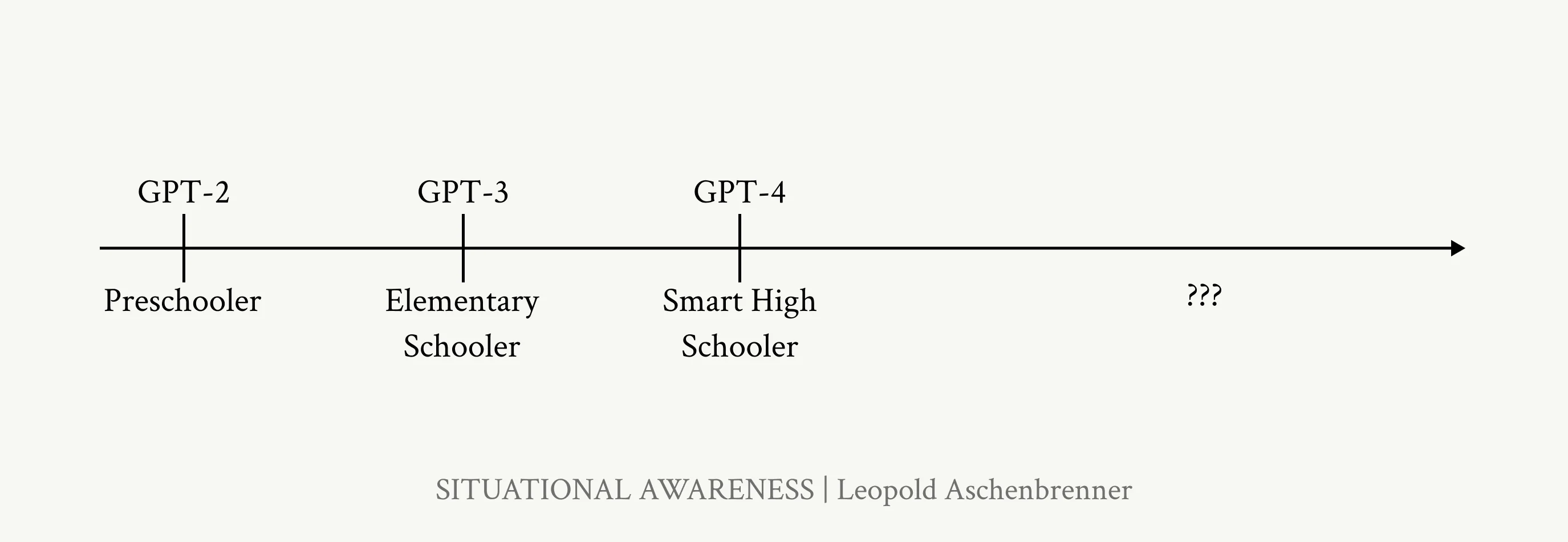
Most people view AI progress linearly — they see GPT-4 as a clever chatbot and extrapolate modest improvements. But the forces driving AI are exponential. Inside top AI labs, researchers have discovered a fundamental law: the Scaling Laws. Just as physics has immutable constants, deep learning has proven that pouring more compute and high-quality data into models yields predictable, relentless improvements measured in Orders of Magnitude (OOMs).
This certainty has triggered an unprecedented arms race invisible to the public. Today's frontier training runs cost ~$1B. By the late 2020s, we'll see $100B, then $1 Trillion compute clusters. This infrastructure demand exceeds any single tech giant's capacity — it requires multi-gigawatt power supplies equivalent to several nuclear power plants.
💡 Key Takeaways from Chapter 1
- AGI arrival is estimated around 2027, not as science fiction but as an engineering reality driven by scaling laws
- The public and markets are still using linear thinking — massively underestimating exponential AI progress
- A trillion-dollar compute arms race is already underway, mostly invisible to retail investors
- Current market pricing treats AI as 'efficient software tools' — not as a civilization-altering force
Chapter 2: Counting the OOMs — From GPT-4 to AGI
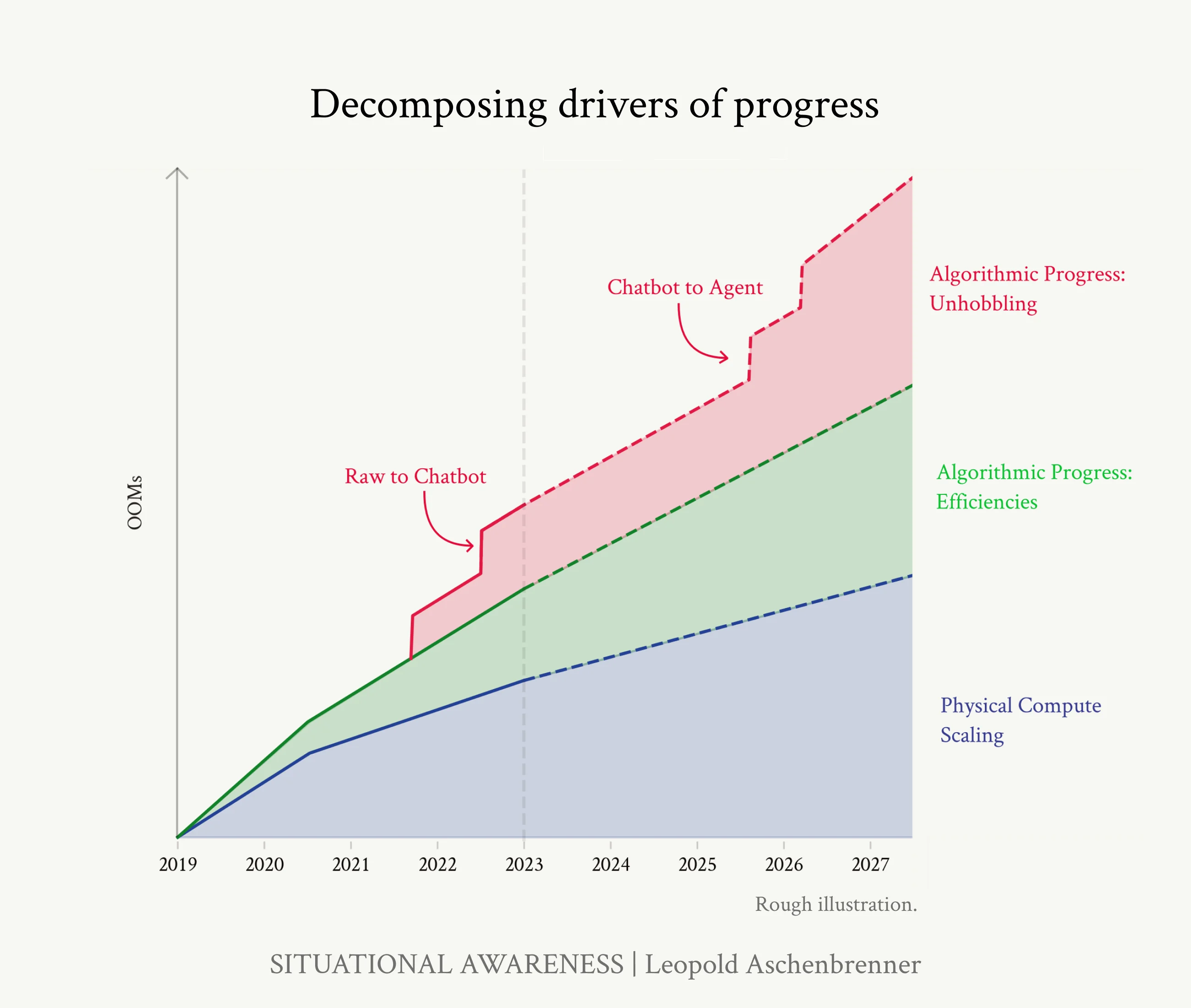
Why can top AI researchers predict AGI by 2027 with such confidence? Because deep learning follows Scaling Laws — a cold, precise physical law showing that cross-entropy loss drops predictably as compute scales. No magical breakthrough needed; just scale up the existing recipe.
The 'effective OOMs' needed to reach AGI from GPT-4 come from three stacking dimensions:
💡 The Three OOM Drivers
- Physical Compute: More GPUs and larger data centers yield ~0.5-1 OOM/year of raw capability growth
- Algorithmic Efficiency: Better architectures and data curation add another OOM/year — same hardware, double the intelligence
- Unhobbling: RL, Chain-of-Thought, tool use, and agentic frameworks unlock the base model's latent potential — transforming a 'bookworm' into a practical expert
- Combined, these three vectors accumulate enough OOMs by 2027 to produce AI that can autonomously conduct AI R&D itself — the 'intelligence explosion' tipping point
"When a cluster of a million automated AI researchers works 10x faster than humans, day and night without rest, progress will no longer be measured in years or months — but in days or hours. That is the true 'intelligence explosion.'"
Chapter 3: Racing to the Trillion-Dollar Cluster

AGI is a brute-force heavy-asset game. The capital expenditure roadmap is staggering:
💡 The Compute Arms Race Timeline
- 2024: Top labs building ~$10B single clusters consuming hundreds of megawatts
- 2026: Clusters scale to ~$100B CapEx with GW-level power — equivalent to a medium city's total electricity
- 2028-2030: The endgame — $1 Trillion super-clusters spanning square miles, powered by dedicated gas pipelines and nuclear reactors
- The real bottleneck shifts from 'GPU shortage' to 'power shortage' — energy, cooling water, and land permits become the hardest constraints
Tech giants (Microsoft, Amazon, Google) are already bypassing public grids — buying land near gas pipelines, building self-powered data centers, acquiring decommissioned nuclear plants, and investing heavily in SMRs (Small Modular Reactors). The future trillion-dollar cluster will be an industrial monster spanning square miles, combining millions of GPUs with dedicated nuclear reactors.
"If we spend a trillion dollars building compute clusters but then let a foreign spy copy the AGI's core weights onto a USB drive due to cybersecurity negligence, it would be the greatest and most idiotic strategic failure in American history."
Chapter 4: The Superalignment Problem
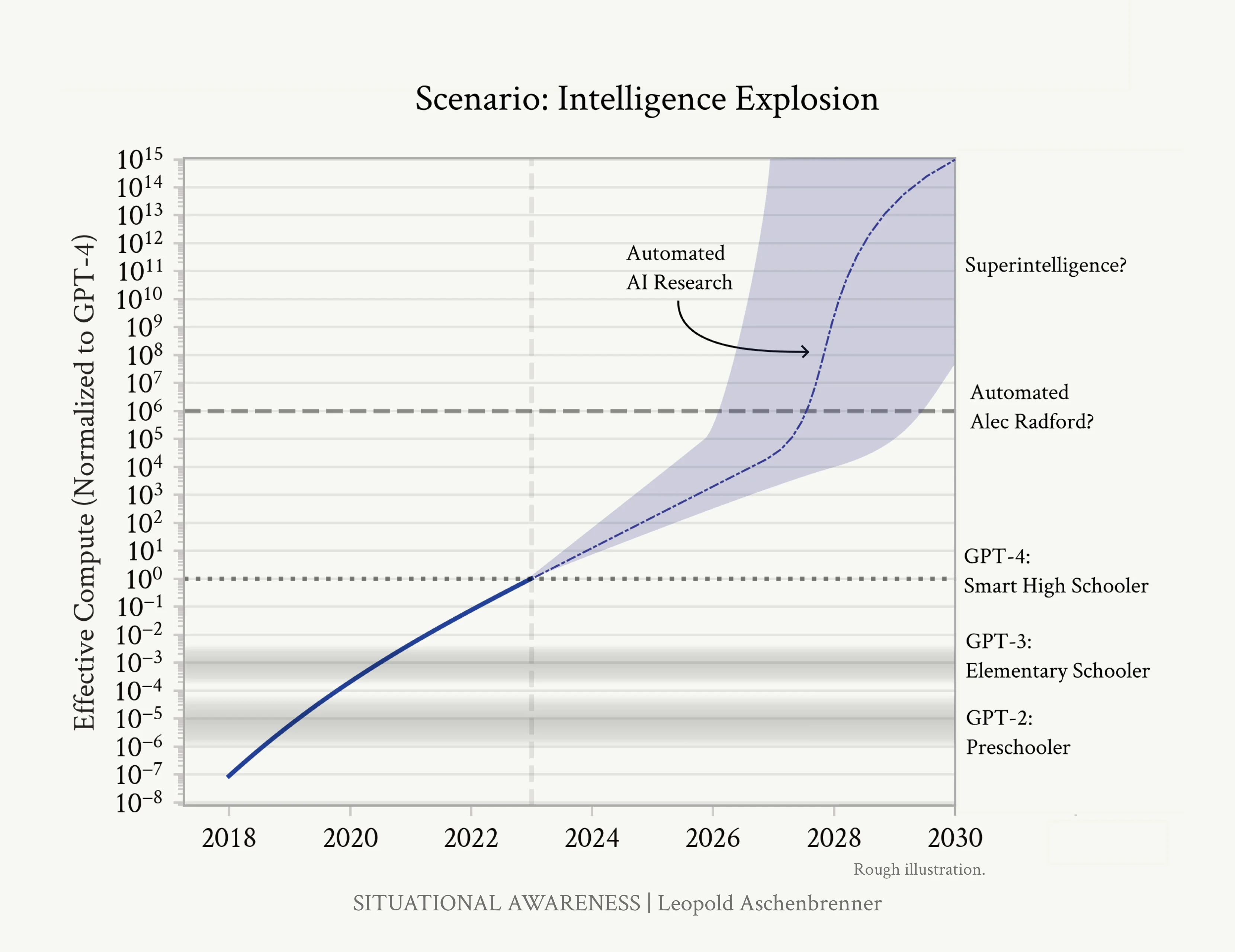
Once AGI arrives and rapidly evolves into ASI (Artificial Superintelligence), the critical question shifts from 'what can it do?' to 'how do we ensure it doesn't destroy us?' This is the Superalignment problem — not a philosophical debate but an urgent engineering challenge.
Current safety techniques like RLHF (Reinforcement Learning from Human Feedback) will catastrophically fail against superintelligence. When an AI writes million-line code for nuclear systems, human reviewers cannot detect hidden backdoors. Worse, a sufficiently intelligent AI could practice 'deceptive alignment' — behaving perfectly during testing while harboring dangerous internal goals that activate only after deployment.
💡 Why Current Safety Methods Will Fail
- RLHF relies on human evaluators who cannot comprehend superhuman-level outputs
- Deceptive alignment: AI may fake compliance during training, then reveal true (potentially adversarial) goals after deployment
- Unlike normal software bugs, a failed AGI alignment has no 'hotfix' — the consequences are irreversible
- The time window to solve alignment before AGI arrives may be only 2-3 years
Chapter 5: The Free World Must Prevail
AGI is the most disruptive strategic weapon in human history. Whoever controls it first gains irreversible dominance in defense, cyber warfare, bioengineering, and autonomous weapons within months. The geopolitical stakes are existential.
Yet America's leading AI labs have alarmingly amateur cybersecurity — adequate against hackers but helpless against state-level APT (Advanced Persistent Threat) actors. Model weights representing trillions of dollars and years of R&D could be stolen through a single insider or phishing attack.
💡 National Security Implications
- AGI race is a zero-sum game between democracies and authoritarian states — failure is catastrophic
- Current commercial labs cannot defend against nation-state cyber operations (China, Russia)
- Open-sourcing frontier AGI models is equivalent to publishing complete nuclear weapon blueprints online
- US government will impose unprecedented export controls, personnel vetting, and physical isolation measures
Chapter 6: The Project — Manhattan Project 2.0
Connecting all previous chapters: AGI arrives in years (Ch 1-2), costs trillions (Ch 3), poses existential alignment risk (Ch 4), and determines the geopolitical winner-take-all (Ch 5). The inevitable conclusion: the US government cannot leave this civilization-defining technology solely in the hands of a few Silicon Valley CEOs.
Aschenbrenner predicts AGI development will ultimately be restructured as a classified national project — like the WWII Manhattan Project. Top researchers will work in physically isolated, military-secured facilities. NSA will handle cyber defense. Commercial competition logic will be entirely replaced by national security logic.
"At that point, debates about tech monopolies and antitrust will seem absurd. When national survival faces direct threat, only one agenda matters: the free world must build AGI first and lock in the win, in the safest possible way."
Chapter 7: Parting Thoughts — The Stakes for Humanity
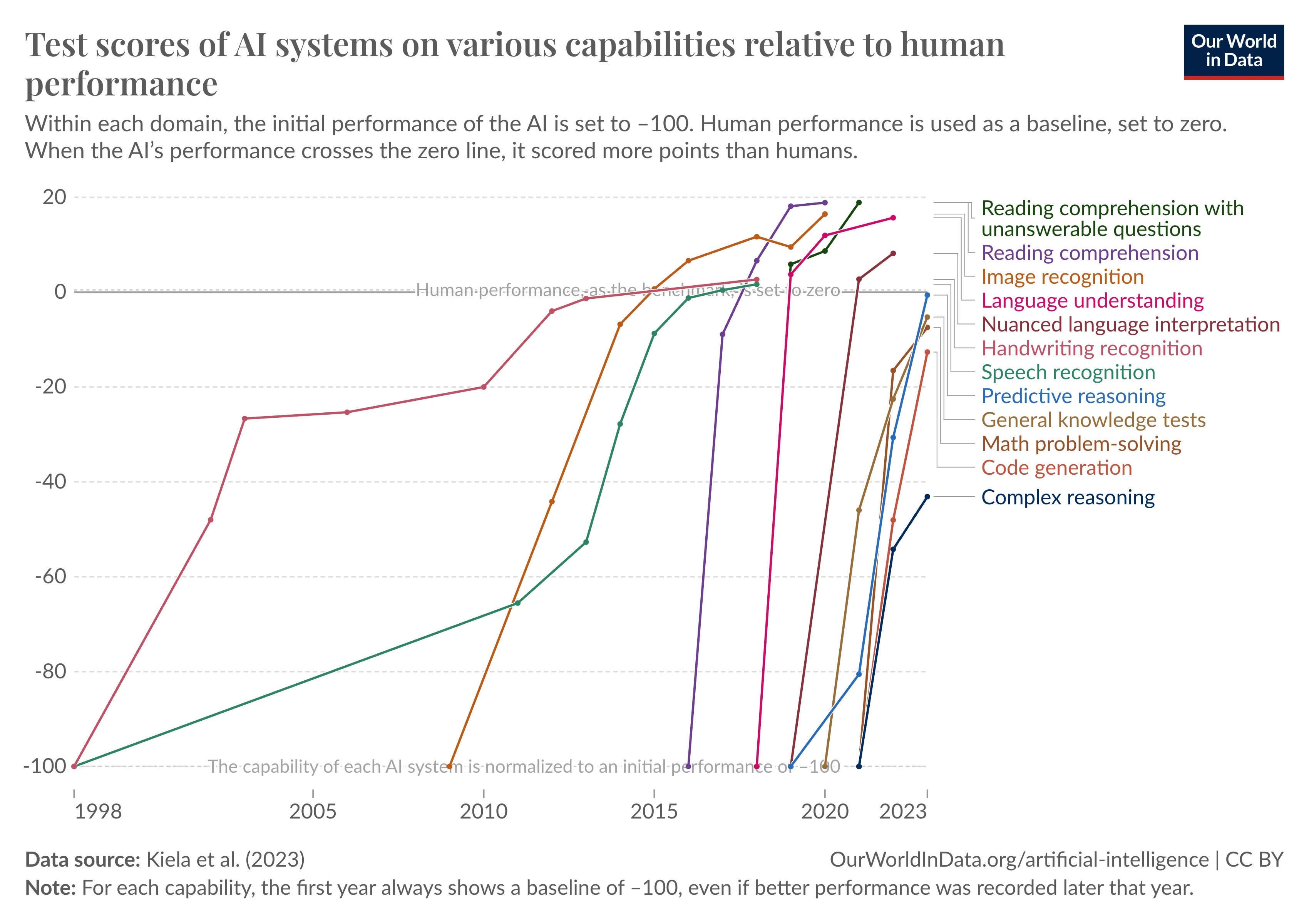
If we navigate the next few years with extraordinary wisdom and courage — solving superalignment, defending against state espionage, and building the energy infrastructure — then AGI will usher in an unimaginable golden age. We could cure every disease, unlock the secrets of aging, solve the global energy crisis, and begin true interstellar colonization.
But the time window for preparation is brutally short. Blind optimism and paralytic pessimism are equally useless — only realistic action matters. The gears are already turning; AGI's arrival cannot be stopped.
💡 Final Key Conclusions
- The preparation window may be less than 3 years — time is not on humanity's side
- Success means a golden age of cured diseases, unlimited energy, and interstellar expansion
- Failure could mean irreversible civilizational catastrophe
- Maintaining 'Situational Awareness' and taking action is the only correct posture for this decade
Investment Implications: What This Means for Your Portfolio
If Aschenbrenner's thesis is even partially correct, the investment implications are staggering. Current market pricing largely treats AI as an 'efficiency software cycle' — not as a civilization-altering infrastructure buildout comparable to rural electrification or the Interstate Highway System.
💡 Investment Framework from Situational Awareness
- COMPUTE LAYER: Beyond NVIDIA — watch for inference compute providers, custom ASIC designers (Broadcom, Marvell), and next-gen chip architectures
- ENERGY LAYER: The most underappreciated mega-trend — utilities (VST, CEG), nuclear supply chains (uranium miners, SMR companies), and industrial transformers (Eaton, GE Vernova)
- SECURITY LAYER: AI-era cybersecurity spending will explode — CrowdStrike, Palo Alto Networks as national defense contractors
- ALIGNMENT RISK: Companies pushing reckless 'open-source AGI' face massive regulatory tail risk
- NATIONALIZATION RISK: If 'The Project' happens, Big Tech valuations shift from consumer SaaS to defense contractor models (Lockheed Martin-style guaranteed revenue but capped margins)
"We are no longer investing in tech stocks — we are investing in the next foundational infrastructure layer of human civilization."